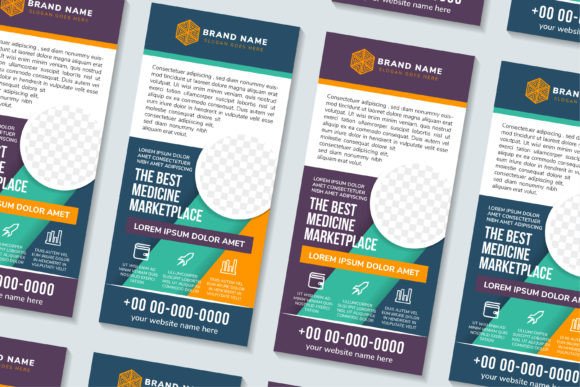
Medicine Marketplace Vertical Banner Review
As a designer who spends more time than I care to admit staring at stitch density charts and testing thread tension, I approach every new graphics asset with a healthy dose of skepticism. We have all been there: you find a stunning vector illustration online, download it immediately, and then spend hours trying to convert it into a viable machine embroidery design only to realize the details are too fine for the needle to handle. That is why reviewing assets before they hit my hoop is part of my workflow.
Today, I am looking at the Medicine Marketplace Vertical Banner. On paper, this looks like a standard Print Templates asset—a vertical banner template for a pharmacy concept with a colorful, modern aesthetic. But does it translate well to thread? Can it hold up as a commercial product on an Etsy shop or a boutique brand? Let’s break down how this embroidery project might actually perform in the real world.
The First Impression: Mood and Layout
The first thing that strikes me about the Medicine Marketplace Vertical Banner is its structural integrity. It is described as a vertical banner with a "vector modern illustration set with photo space." This layout is inherently safer for embroidery than a chaotic, all-over print design. The vertical orientation suggests a tall, narrow composition, which naturally aligns with common hoop size constraints. Most home and commercial machines struggle with wide designs, but a vertical banner fits comfortably within standard 4x4, 5x7, or even 6x10 hoops.
The theme is clean and professional. For a pharmacy or medicine marketplace concept, the visual personality feels trustworthy and organized. In the context of handmade product creation, this translates to a sense of reliability. When a customer sees an embroidered design that is clear, uncluttered, and thematically appropriate, it subconsciously signals quality. The inclusion of a "photo space" in the original vector file is interesting; however, since we are dealing with thread, not ink, that space likely represents negative space or a simplified graphic element that allows the eye to rest. This breathing room is crucial for stitch clarity.
Real-World Application: Where Would This Stitch?
I spent some time imagining where this design would live. The most immediate fit is a custom tote bag design. A canvas tote with a vertical banner motif stitched on the front pocket or center panel creates a chic, utilitarian look. It works perfectly for a small business owner who wants branded merchandise that doesn’t scream "advertisement" but rather whispers "curated lifestyle."
Beyond bags, I see potential in sweatshirt embroidery placed vertically along the side seam or centered on the back. The vertical nature of the banner mimics the flow of the garment. It could also work beautifully as a large embroidered patch intended for application onto denim jackets or aprons. If you are selling custom apparel, this design offers a versatile anchor point that can be paired with simpler text elements above or below it.
For the nursery market, this could be adapted into a baby embroidery piece, perhaps on a muslin blanket or a hooded towel. The "medicine" theme might seem clinical, but if the colors are soft pastels (which the "colorful design" description allows for), it can be reinterpreted as "health," "care," or "wellness." This flexibility is what separates a good digital embroidery file from a great one. It adapts to the fabric texture and the intended recipient.
Technical Considerations and Potential Pitfalls
While the concept is strong, we must address the technical realities of converting a vector graphic into a stitch file. The description mentions a "modern illustration set," which often implies sharp lines and potentially complex shapes. Here is where caution is needed.
- Small Details: If the banner includes tiny text or intricate medical icons (like a pill shape or a cross), these may become muddy during stitching. Tiny details often require high stitch density, which can make the fabric stiff and difficult to hoop. Always inspect small details in your software before committing to production.
- Thread Colors: The design is described as "colorful." While vibrant threads exist, using too many colors in a single pass can increase production time and thread breaks. I recommend simplifying the palette. Instead of ten different shades of blue and green, try to achieve depth using just three or four complementary thread colors.
- Fabric Texture: This design will shine on smooth fabrics like cotton canvas or felt. However, avoid textured fabrics like heavy terry cloth or loose-weave linen unless you use a heavy-duty stabilizer. The contrast between the fabric texture and the smooth satin stitches of the banner could result in a messy finish.
Where to Use Carefully
There are specific scenarios where this design might struggle. Avoid attempting this on stretchy fabrics like jersey knit without proper stabilizers, as the vertical lines may distort. Similarly, curved surfaces like baseball caps are risky; a flat vertical banner will not conform well to the crown of a hat. Stick to flat surfaces like aprons, pillow covers, or kitchen towels for the best results.
Also, consider the end-user. If this is for a personalized gift meant for frequent washing, ensure the design does not have excessive decorative accents that could snag. Durability is key for items like kitchen towels or holiday gifts that will see heavy use.
Impact on Brand and Sales
From a business perspective, the Medicine Marketplace Vertical Banner has strong potential for Etsy sellers and small shop products. In a crowded digital marketplace, visual appeal drives clicks. A clean, professional-looking embroidered item stands out against poorly executed, pixelated, or overly busy designs. This asset supports brand consistency because its structure is predictable and scalable.
When creating printable mockups for your listings, this design allows you to showcase versatility. You can present it on a neutral background to highlight the colors, or on a dark fabric to demonstrate contrast. This helps build customer trust by showing exactly what they are buying. Furthermore, if you are selling the digital file itself, the "modern illustration" aspect makes it attractive to other designers looking for design assets to incorporate into their own larger projects.
Practical Designer Notes for Execution
Before you start stitching, here is my checklist for making the most of this design:
- Test on Scrap Fabric: Never run a new design directly onto your final product. Test it on scrap pieces of the same fabric type to check for puckering or misalignment.
- Check Contrast: View your design in black and white mode in your embroidery software. This helps you see if the thread colors have enough contrast to remain distinct after stitching.
- Review Stitch Density: High density saves time but can ruin delicate fabrics. Lower the density if you are working with thin or lightweight materials.
- Confirm Licensing: Since this is a graphics asset, double-check the license terms. Are you allowed to sell finished physical items? Can you sell the digitized version? Clarifying this protects your craft business from legal issues.
- Use Proper Stabilizer: For a vertical banner, a cut-away stabilizer is often best if the item will be stretched during hoop placement, such as a tote bag. For woven items, tear-away may suffice.
Ultimately, the Medicine Marketplace Vertical Banner is a solid foundation for a variety of embroidery projects. It balances aesthetic appeal with practical usability. By paying attention to the technical details—hoop size, stitch type, and fabric choice—you can transform this vector concept into a high-quality, desirable finished product that resonates with customers. Whether you are decorating a cap or launching a line of wellness-themed merch, this design offers a professional starting point that respects both the art of embroidery and the needs of the buyer.